
Bitcoin dominance is a widely referenced metric in the cryptocurrency world, often discussed as a key indicator for market trends. However, its meaning and calculation are sometimes misunderstood, leading to confusion about how to use it effectively. This article breaks down what Bitcoin dominance really represents, how it’s calculated, and why discrepancies arise depending on data sources.
What Is Bitcoin Dominance?
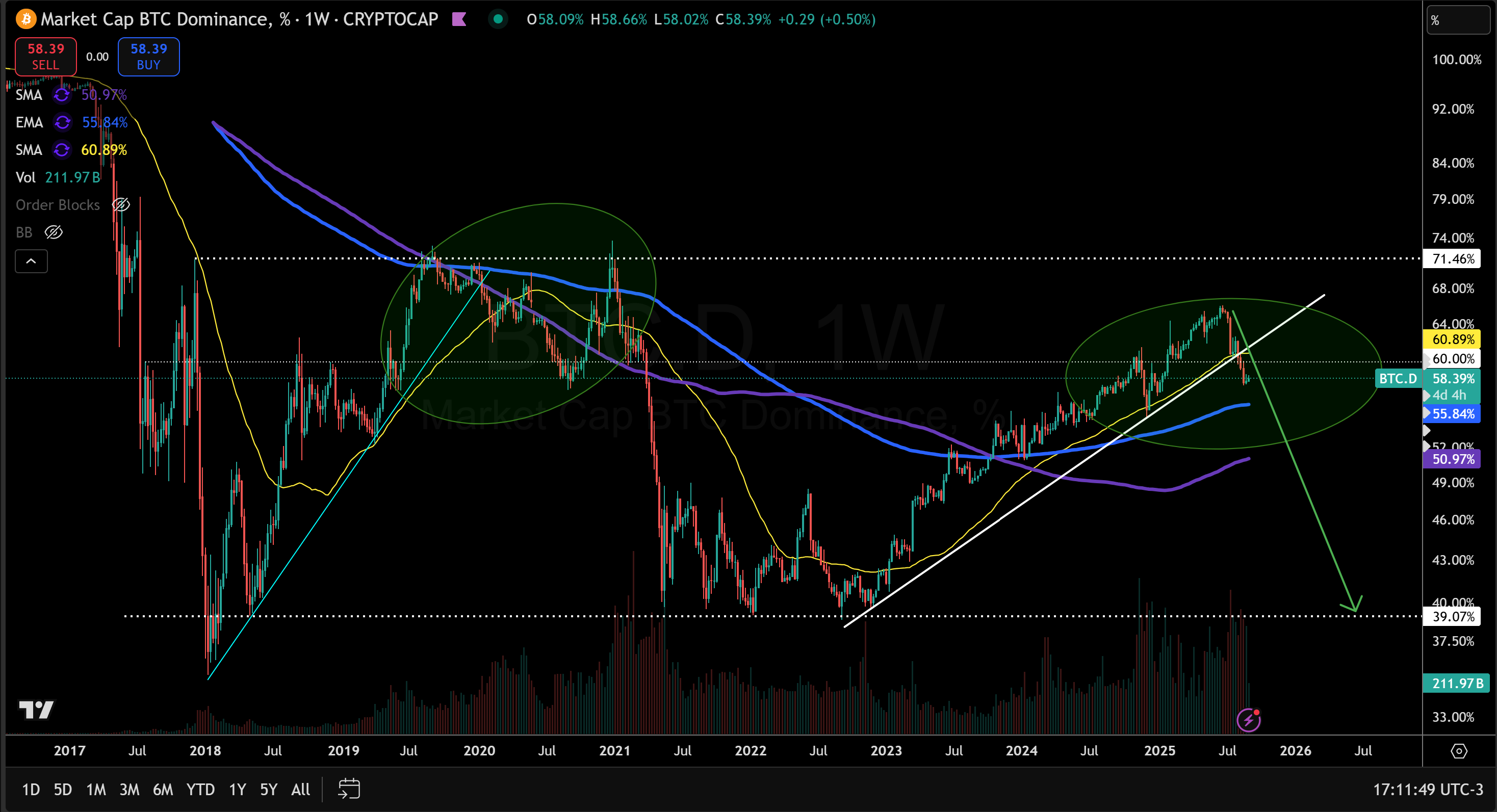
Bitcoin dominance refers to the percentage share of Bitcoin’s market capitalization relative to the total market capitalization of all cryptocurrencies combined. It essentially measures Bitcoin’s weight or influence in the broader crypto market. For example, if Bitcoin dominance is 57%, it means Bitcoin’s market cap makes up 57% of the total crypto market capitalization.
Many market participants interpret Bitcoin dominance as an indicator of Bitcoin’s strength compared to altcoins or as a predictor of market direction. However, understanding how this number is derived is crucial to avoid misleading conclusions.
How Is Bitcoin Dominance Calculated?
The calculation is straightforward in theory:
Bitcoin Dominance = (Bitcoin Market Capitalization) ÷ (Total Cryptocurrency Market Capitalization)
- Bitcoin market capitalization equals the current price of Bitcoin multiplied by the number of Bitcoins in circulation.
- Total cryptocurrency market capitalization equals the sum of the market caps of all cryptocurrencies listed across exchanges.
When broken down simply, the formula should produce a consistent figure. Nevertheless, in practice, various factors affect its reliability.
Why Are Bitcoin Dominance Figures Different Across Data Providers?
One might expect uniform Bitcoin dominance figures from different market data aggregators, but this is not the case. For instance, on a single day, one source might report Bitcoin dominance at 57.35%, another at 56%, and yet another at 55%. This variation increases confusion about what is “correct.”
The main reason for these discrepancies lies in how the total cryptocurrency market capitalization is calculated:
- Inclusion Criteria Variability: Different platforms include different sets of cryptocurrencies. Some only consider top coins by market cap or liquidity, while others list thousands of tokens, including very low-value and infrequently traded assets.
- Data Quality and Reliability: The crypto market is rife with “junk” tokens—cryptocurrencies with minimal use, negligible community support, or even fraudulent intentions. Including these can artificially inflate total market cap figures.
- Dynamic Market Environment: New cryptocurrencies are created daily, and tokens can rapidly gain or lose value. Aggregators continuously update their databases but may have different update frequencies or sources.
Thus, the total market capitalization figure can vary significantly depending on the data provider’s methodology, which directly impacts the Bitcoin dominance metric.
What Does This Mean for Crypto Investors and Analysts?
Understanding the limitations of Bitcoin dominance is key:
- It should not be treated as a precise, standalone quantitative indicator.
- Variations in the underlying data mean that using Bitcoin dominance to predict market movements requires caution.
- Instead, Bitcoin dominance can serve as a general directional reference to gauge Bitcoin’s relative strength in the crypto ecosystem.
- Analysts and traders should consider cross-referencing multiple sources and complement Bitcoin dominance with other metrics, such as trading volume, liquidity, and sentiment indicators.
Conclusion
Bitcoin dominance provides a useful lens on Bitcoin’s positioning within the larger cryptocurrency market. However, its straightforward calculation masks nuances tied to data quality and market composition. Recognizing why Bitcoin dominance differs between data providers allows market participants to interpret this metric more effectively and avoid overreliance on a single figure. Ultimately, Bitcoin dominance is one piece of the puzzle rather than a definitive predictor of market behavior.
By MegaW Crypto - Empowering crypto investors since 2016
Subscribe to MegaW Crypto PRO
Disclosure: Authors may be crypto investors mentioned in this newsletter. MegaW Crypto Crypto newsletter, does not represent an offer to trade securities or other financial instruments. Our analyses, information and investment strategies are for informational purposes only, in order to spread knowledge about the crypto market. Any investments in variable income may cause partial or total loss of the capital used. Therefore, the recipient of this newsletter should always develop their own analyses and investment strategies. In addition, any investment decisions should be based on the investor's risk profile.